Why This Site Is Deliberately Boring
Many websites become complicated one reasonable decision at a time. A component needs state, state needs an API, the API needs authentication, and the growing system needs more tooling to observe and maintain it. None of those choices is automatically wrong. They are simply expensive when the original job is to publish a document.
This site starts from that job.
Its purpose is to make writing available at stable URLs in a form that browsers already understand. It does not need to behave like an application, identify a reader, or negotiate with several services before displaying a paragraph. For this purpose, boring technology is a useful constraint.
Boring means predictable
A page here has a short path from source to reader. Hugo turns Markdown, templates, and local media into static files. A local audit examines the generated output. Publication transfers that output to a static host. A browser then receives ordinary HTML and a small local stylesheet.
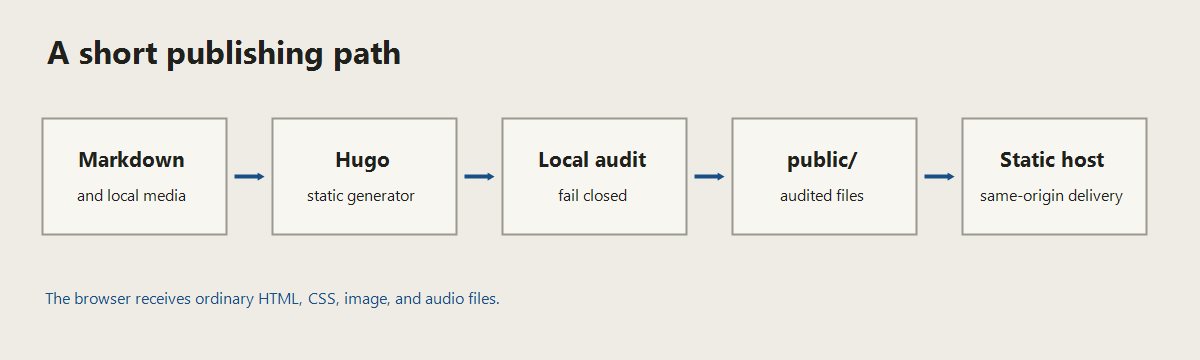
The publishing path has five explicit stages and no browser-side application stage.
There is no client bundle to initialize and no interface hidden behind a loading state. The document remains useful if optional media cannot be played. Browser features such as following links, selecting text, saving a page, and using a reader mode continue to work in their ordinary way.
Predictability is not glamorous, but it is valuable. It gives both the reader and the maintainer fewer states to reason about.
Speed without scorekeeping
A fast site is pleasant, but performance claims are easy to turn into theater. A score collected on one device, connection, or date is not a permanent property of a website.
The more durable decision is architectural: this site does not ship an application runtime to display an essay. It avoids third-party fonts, analytics libraries, advertising code, and remote media embeds. A page cannot spend time downloading a client bundle that does not exist.
This does not guarantee an identical experience on every network. It does make the amount of work requested from the browser easier to see and keep small.
Privacy with a smaller data trail
The site does not need to know who is reading. It sets no cookies, presents no account system, and adds no analytics or advertising identifiers. Images, audio, and styles are served from the same origin instead of quietly contacting unrelated services.
That is a limited and specific claim. A hosting provider may still process request metadata needed to deliver traffic, operate infrastructure, or respond to abuse. Static publishing does not make the network disappear. It does avoid adding a separate visitor profile merely to measure attention.
Security through fewer moving parts
Removing features can remove failure modes. With no form, database, authentication flow, administrative interface, or browser-side script, there are fewer inputs to parse and fewer privileges to defend.
That does not make the site invulnerable. Build tools, source files, hosting configuration, and domain control still matter. Security headers can constrain browser behavior, but they do not replace careful maintenance.
The practical advantage is narrower scope. The generated artifact can be inspected as a finite collection of HTML, CSS, XML, images, and audio. Local checks can reject unexpected executable content or network dependencies before publication.
Content before machinery
Writing should not depend on a particular interface remaining fashionable. Markdown is readable without the site. Generated HTML is useful without JavaScript. Local media stays with the article that explains it. RSS allows a reader to follow new work without creating an account or surrendering an email address.
These choices do not make the content permanent by themselves. Domains expire, formats change, and maintainers make mistakes. They do make migration and preservation less mysterious because the important material is stored in ordinary files with explicit relationships.
What simplicity gives up
A narrow site cannot provide every convenience. There is no comment system, personalization, client-side search, reaction counter, or automatic recommendation feed. Readers who want updates can use RSS. Readers who want to respond can do so in a place they control.
Those limits are intentional, but they are not universal advice. A collaborative application, store, or real-time service has different needs. Complexity is justified when it serves the actual task. Here, most of it would serve the machinery around the writing instead.
A local media test
This post is also the first page bundle on the site. The diagram above and the audio file below are stored beside the Markdown source and published from the same origin.
The audio is a functional media sample, not narration, music, or a recording of the author. It contains three brief synthesized tones, each higher than the one before it. Its purpose is to verify that a post can include optional local audio without involving an external player or media service.
Text equivalent: Three short tones rise in pitch from low to high over about one second.
Calling the sample what it is matters. A generated sound should not be presented as an author recording, and a technical demonstration should not be disguised as editorial material.
A constraint worth keeping
“Boring” is not a visual pose or nostalgia for an earlier web. It is a continuing test for each addition: does this make the writing more useful, or does it merely expand the system?
For now, plain documents, local assets, and a small build pipeline are enough. That is not an absence of design. It is the design.